
1 min read
Health Index Model of East Java Province using Ridge Regression
Ridge Regression is used to predict East Java's Health Index by handling multicollinearity
Ridge RegressionMulticollinearityOLS
Features
Tech Stack
R Studio
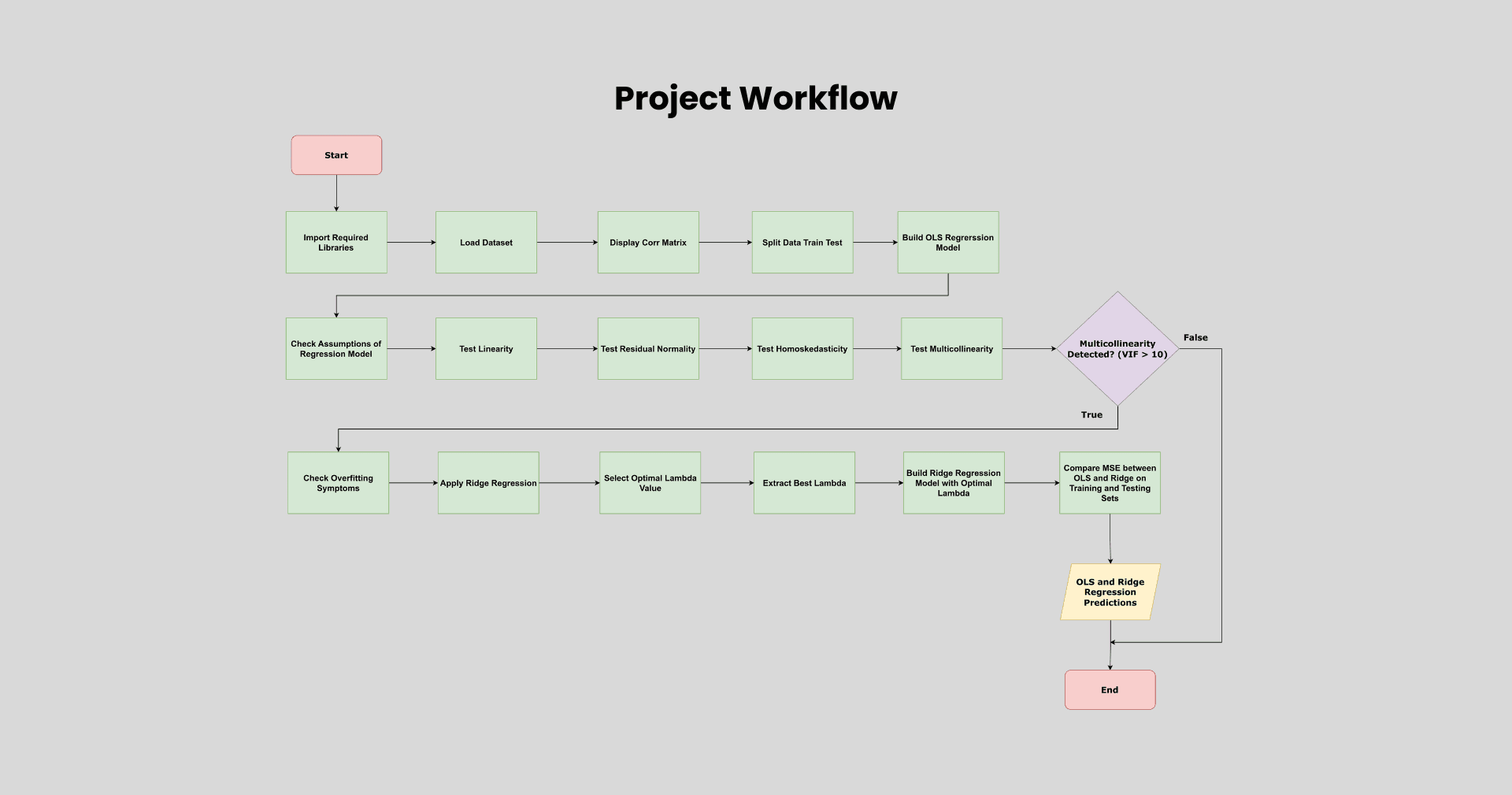
Ridge Regression is used to predict East Java's Health Index by handling multicollinearity
This project explores the application of Ridge Regression to model the Health Index of East Java Province. In statistical analysis, regression is a widely used method for examining the relationship between independent (predictor) and dependent (response) variables. However, traditional linear regression techniques, particularly those based on Ordinary Least Squares (OLS), often become unreliable when classical assumptions such as the absence of multicollinearity are violated.
Multicollinearity occurs when predictor variables are highly correlated, leading to unstable parameter estimates and invalid inference. To address this, Ridge Regression is introduced as a modern alternative. It modifies the OLS method by adding a small bias constant to the diagonal of the XᵀX matrix, which helps stabilize the coefficient estimates by reducing variance, even in the presence of strong correlations among predictors.
This study aims to build a predictive model of the health index by applying Ridge Regression to overcome multicollinearity issues and produce more reliable and interpretable results.